Stop Procrastinating: 7-Day Workbook Plan for Momentum

Finally Focused: The Anti-Procrastination Workbook for Daily Momentum
Procrastination rarely comes from laziness. More often, it shows up when the next step feels unclear, the emotional reward feels too far away, or distractions are perfectly timed to steal attention right when action is needed. Finally Focused: The Anti-Procrastination Workbook – Productivity Ebook & Focus-Building Guide with Time Management Tools is built to turn vague intention into specific movement through guided workbook prompts, repeatable focus routines, and practical time management tools designed for daily momentum.
What “procrastination” looks like in real life (and why it keeps repeating)
Procrastination often looks productive on the surface. The calendar is color-coded. Notes are organized. The “plan” is polished. Yet the real work doesn’t start—or it starts only when pressure spikes.
- Common patterns: endless planning, constant task-switching, avoiding high-stakes work, and starting only under a deadline.
- Hidden drivers: unclear scope (“What does done look like?”), fear of doing it wrong, perfectionism, decision fatigue, and low-energy windows that get spent on high-effort tasks.
- Why willpower alone fails: environment and task design often overpower motivation—especially when notifications, open tabs, and ambiguous tasks are competing for attention.
- A better approach: build friction against distractions and reduce friction to start, so beginning becomes the default.
Research and clinical guidance often frame procrastination as a coping response—something used to manage stress or discomfort in the moment. The American Psychological Association (APA) discusses procrastination and coping strategies that align with this “reduce discomfort, increase clarity” approach.
How Finally Focused is structured: workbook prompts + tools you can reuse
Many productivity resources explain what to do. A workbook is different because it pulls the action out of you—one prompt at a time—until you have a clear next step you can start immediately.
- Workbook-first design: guided questions and templates translate goals into next actions, so you’re not stuck deciding where to begin.
- Focus-building routines: short, repeatable sessions lower the “startup cost” of work. The goal is less drama and more consistency.
- Time management tools: planning blocks, prioritization prompts, and review checkpoints reduce drift midweek.
- Designed for momentum: emphasizes starting, finishing, and resetting—so progress survives real life instead of collapsing when the perfect plan breaks.
For those who like evidence-backed management principles, Harvard Business Review regularly covers decision-making, time management, and focus—useful context for why smaller commitments and clearer outputs tend to win over ambitious, fragile schedules.
A simple 7-day momentum plan using the workbook
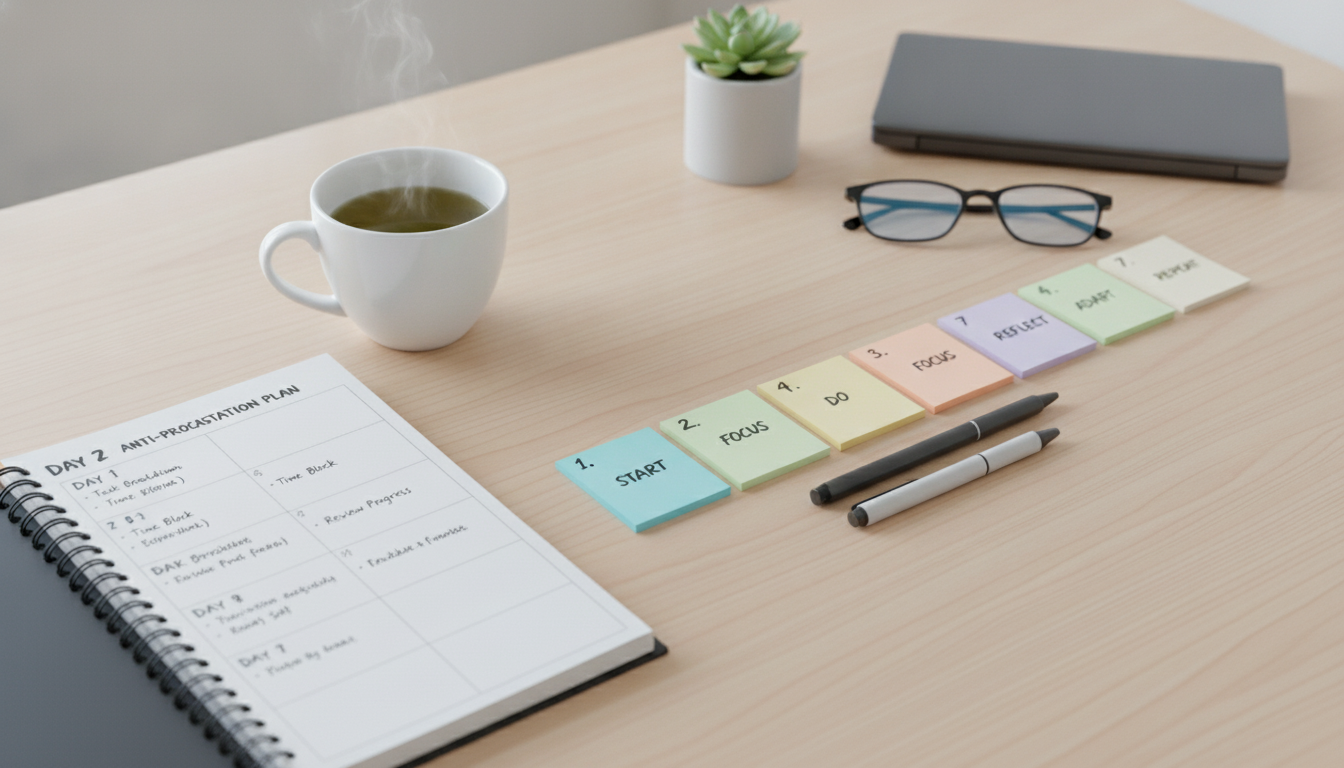
| Day | Goal | Suggested time |
|---|---|---|
| 1 | Define the priority and what “done” means | 20–30 min |
| 2 | Turn the priority into 5–15 minute steps | 30–45 min |
| 3 | Set up distraction safeguards and a restart script | 20–30 min |
| 4 | Complete 2 focused sprints + stop on purpose | 2 × 25 min |
| 5 | Review and rescope the plan | 15–25 min |
| 6 | Finish line routine: wrap, log next action, schedule | 15–20 min |
| 7 | Reflect, keep the best tools, plan next week | 20–30 min |
Time management tools inside the method: priority, planning, and follow-through
- Priority filters: decide what matters today versus what can wait without guilt, so attention isn’t split between ten “kind of urgent” items.
- Scheduling that works: time-block for focus windows, plus buffer blocks to prevent one interruption from destroying the whole plan.
- Task clarity: rewrite “big” tasks into visible outputs—draft, outline, list, email, call, submit—so your brain knows what action looks like.
- Progress tracking: short reviews prevent the silent slide back into avoidance (the week where nothing “bad” happened, but nothing moved either).
- Energy-aware planning: match demanding work to high-energy periods and use low-energy slots for admin. Sleep and recovery matter more than most schedules admit; the National Institutes of Health (NIH) has extensive information on sleep and health that connects directly to attention and performance.
Who this workbook is best for (and when it may not be enough)
How to get results faster: setup tips that make the tools stick
If you want a guided, reusable framework built around these principles, Finally Focused: The Anti-Procrastination Workbook – Productivity Ebook & Focus-Building Guide with Time Management Tools is designed to keep the process simple enough to repeat—even on busy weeks.
Related digital toolkits that pair well with a focus system
- Turn momentum into revenue experiments: Find Your Next Big Business Idea Toolkit – Trendspotting, Market Gaps, Validation, MVP Tests & Idea Scorecard (Ebook) can help reduce “busy work” by forcing clarity around what to test and what to ignore.
- Reduce money stress that fuels avoidance: Budgeting Like a Pro: Complete eBook – Personal Finance Planner, Zero-Based Budgeting, 50/30/20, Pay-Yourself-First, Debt Payoff & Savings Plan can lighten cognitive load, making follow-through easier.
- Cut decision fatigue for travel and logistics: Eco-Friendly Traveler Checklist | Sustainable Travel Digital Download | Zero Waste Packing List, Green Travel Tips Guide keeps routine choices from stealing the attention you need for higher-value work.
FAQ
How is a workbook different from a typical productivity book?
A workbook focuses on prompts, exercises, and templates that guide action immediately, not just concepts. Instead of hoping motivation shows up, you use structured questions to define “done,” choose a next step, and repeat a routine that’s easy to restart.
How long does it take to see results with an anti-procrastination workbook?
Small improvements often show up within days when you commit to short, consistent work sprints. Deeper habit change typically takes weeks, and a simple 7-day momentum plan can provide enough structure to build early traction.
What if procrastination is caused by anxiety or attention difficulties?
A workbook can be supportive by adding clarity, reducing overwhelm, and creating gentle routines, but it isn’t a substitute for professional care. If anxiety or attention challenges significantly disrupt daily functioning, combining productivity tools with guidance from a qualified professional can be the most effective path.










Leave a comment